Big Guts
Building and closing food business from zero
1000+
Orders
6000+
Sticks Sold
4.9
Rating

overview
Project background
After being laid off from one of Indonesia’s largest technology companies, I returned to Malang and began reconsidering my long-term direction.
my goal
I wanted to build something tangible, something I could own, improve, and potentially grow into a sustainable business.
The Opportunity
Looking for a product people would buy repeatedly
Malang is filled with students, affordable food, and small culinary businesses. I visited different food stalls, observed what people ordered, and studied which businesses consistently attracted customers. Instead of immediately deciding what to sell, I started by observing the local market.


Then a pattern emerged
People preferred affordable and familiar food.
Successful businesses usually had simple, repeatable menus.
Many traditional food sellers had limited branding.
Most offered similar products without a distinctive identity.
Online ordering and delivery were becoming increasingly important.
This led to my initial hypothesis
A familiar local product could become more desirable through a distinctive recipe, stronger branding, consistent quality, and a more convenient purchasing experience.
What we need
Defining the product
I considered several types of food before choosing satay. Satay was already familiar to Indonesian customers, relatively easy to portion, suitable for delivery, and flexible enough to be developed into multiple products.
setting up the foundation
Defining our principles
Familiar
Recognizable and approachable.
Distinctive
Stand apart from conventional satay.
Repeatable
Produce consistent results.
Small to no waste
No left-over ingredients
Developing the Product
Turning a recipe into a repeatable experience
I tested different ingredients, marinades, cooking methods, portion sizes, and preparation workflows. The goal was not only to create something delicious. I also needed a product that could be prepared consistently by different people during busy operating hours.


The development process included:
Testing on marinade and seasoning ratios
Portion and pricing experiments
Defining kitchen workflow
Testing different sauces and side dishes
Creating standards for storage and prep
And I did it, it tasted comforting and familiar
*I tested to families, friends, and all of them liked it. It was the best satay they ever tried.
Taste alone wasn’t enough
I don’t want conventional satay. We needed a stronger differentiator. I settled on two defining qualities
Bigger portion
Bolder flavor
building the Brand
Making traditional food feel bold and memorable
Many competing food businesses offered familiar menus with limited differentiation. I saw branding as an opportunity to make Big Guts recognizable before customers even tried the product. I developed a visual identity that felt expressive, playful, and slightly rebellious. The brand was designed to appeal to students and young adults without making the product feel inaccessible or overly premium.
Logo

Packaging
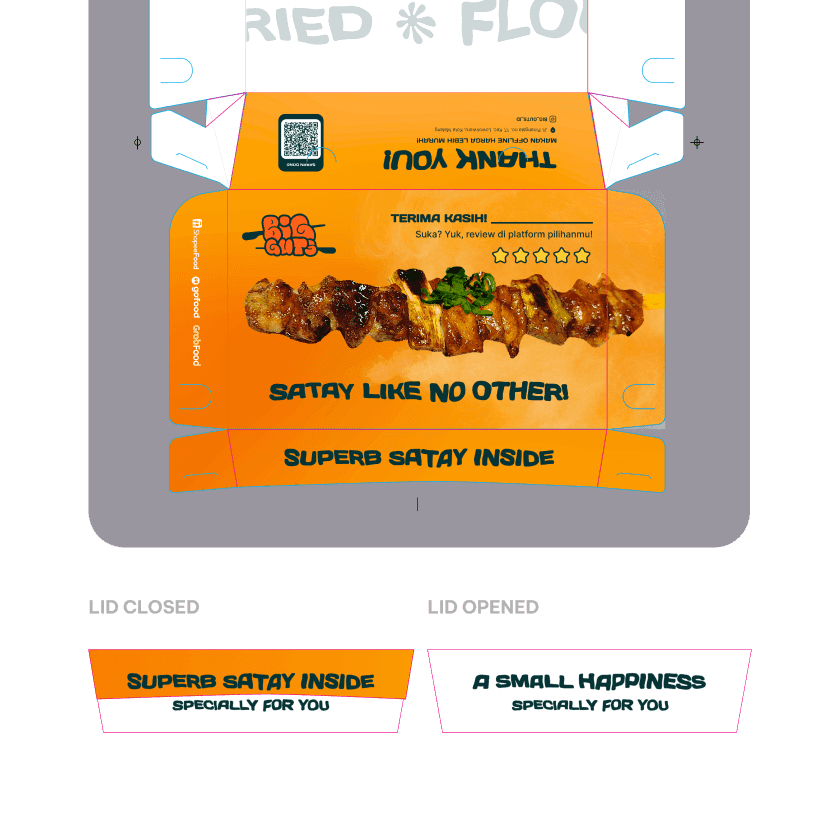
Menu

Promotions

The First Market Test
Our first activation failed
I brought Big Guts to a Car Free Day event to test the product in a real market environment. We spent hours preparing with little to no sleep, but very few people purchased the product.
The experience was frustrating,

It exposed several problems:
A good product wasn’t enough. I needed to make it easier to try and worth talking about.
Changing the Acquisition Strategy
From waiting customer to creating trial
I shifted the business toward online delivery platforms, making the product easier to discover and purchase. The first week was operationally chaotic. We had no mature SOPs, orders were occasionally mixed up, and the kitchen workflow was still inefficient.

Every order gave us information to improve
Order preparation
Planned prep quantities and stages to cook and fulfill incoming orders faster.
Packaging
Added aluminum foil to retain heat, addressing complaints about cold sate on delivery.
Kitchen coordination
Assigned clear roles for cooking, packing, checking orders, and production and restocking.
Inventory management
Tailored storage to each ingredient to reduce spoilage and made stock visible for easier checks.
Product consistency
Standardized measurements, portions, preparation, and cooking times for consistent taste and quality.
Communication
Held closing reviews to discuss problems and agree on improvements for the next day.
creating trial & word of mouth
I later returned to Car Free Day with different strategy

Instead of depending only on direct sales, we gave people free satay if they posted it on Instagram and left an honest review. The goal was to reduce the barrier to trial while generating social proof.
The activation sold out our stock and created an immediate increase in awareness. In the following weeks, online orders began to stabilize.
Early Validation
Customers did not just try it, some ordered almost everyday
Within the first four months, with only 6 opening hours per-day, Big Guts achieved:
1000+
Orders
6000+
Sticks Sold
200+
Reviews
4.9
Rating
These results validated several parts of the original hypothesis:
closing and rebuilding
Customers gave me a reason to try again
During this period, I was also going through a difficult personal situation. At the same time, an employee left, increasing the workload on the remaining team. I was exhausted and no longer had the capacity to operate the business properly, so I temporarily closed Big Guts for one month.

I decided to try again
I hired new employees, clarified our SOPs, reorganized the kitchen workflow, and attempted to make daily operations less dependent on me.
Reopening proved that customers still wanted the product. It also exposed deeper problems that customer loyalty alone could not solve.


However, demand alone did not mean that the business was sustainable.
Sustainability
Desireable product, fragile business model
Low awareness-to-purchase conversion
Influencer exposure drove few purchases. Unfamiliar satay without peanut sauce needed more explanation than a quick buying decision allowed.
Conditional demand
Sales grew slowly and dropped sharply during rain and university holidays, exposing our reliance on nearby students.
Thin and unpredictable margins
Chicken prices doubled and chili prices tripled. Raising prices risked losing students; absorbing costs threatened the business.
Operational fragility
Uneven workloads, inconsistent attendance, and limited cross-training left us dependent on individuals. One departure increased pressure on the team, contributing to further resignations.
Big Guts had achieved meaningful customer desirability, but its business viability and operational feasibility remained fragile.
Decision and Lessons
Persistence was no longer enough
Continuing Big Guts would have required restructuring the menu, pricing, positioning, staffing, and operating model without clear evidence that the potential growth would justify the additional investment.
I eventually made the difficult decision to close the business. Letting go was painful because Big Guts was something I had built from the ground up and worked incredibly hard to sustain.


“Building Big Guts taught me how to turn an idea into reality.
Closing it taught me how to evaluate that reality honestly.”
Reflection
So what are the lessons?
Validate enough demand, not just enthusiasm
Customers liked the product, and some returned regularly. I learned to test whether enough people would buy, often enough and at the right price, to sustain the business.
Leave room for costs to rise
My production costs were already high, leaving little buffer when ingredient prices increased. I needed to design portions, recipes, and pricing around a margin that could absorb those changes.
Production effort limits growth
Satay required substantial preparation and hands-on cooking, limiting how much we could produce and sell. I learned to evaluate a product’s workload and production capacity alongside its taste and appeal.
Build accountability and reasons to stay
Assigning tasks was only the start. I needed clear ownership, regular follow-up, and cross-training, alongside manageable workloads and an understanding of what would make employees stay.